

Oops !! It is some days since our last blog. There are a number of factors contributing to this delay.
Not the least is the complicated communication systems in France. We keep losing WIFI and having trouble with topping up the phone card in our iPad which is our means of connecting WIFI away from major towns.
Another important one is the time factor. At the end of each walking day there is the need to buy food, wash clothes, have a shower and fall into bed.
Back to the Via Francigena.
Since our last blog we have walked an additional approximately 180 km through what the French call ” Le Pas-de-Calais” and another 185 km to Reims. This region includes the area of the battle of the Somme in the First World War. We have been surprised by the intensity of the memory of this event right throughout this region. On the way we passed a British cemetery beautifully maintained with about 700 headstones. There are Australian and British cemeteries scattered all over. Every town and village has some reminder. There were 16,000 Australian troops died and many more seriously wounded in the Somme region alone.

France is very beautiful and the French are the kindest most helpful and friendliest people we have encountered in all our travels. We have been fortunate with the weather. Although it has been quite cold most days it has been fine except for one day walking 23.5 km in the freezing rain from Arras to Bapaume with a strong wind blowing against us.
The highlights of this period since our last post are: In the village of Wisques there are two abbeys. One is a monastery St Paul that is all monks and does not allow women to stay there. The other is Notre Dame that is occupied by Nuns. Both are of the Benedictine order. Notre dame was built in 1891 in a neo-Gothic style. Saint Paul dates to the 15th century. The nuns abbey was taken by the Germans and they fled to Holland and returned in the late forties.

Here we were greeted by the bubbly Sister Lucy who is famous among Pilgrims and locals. She welcomed us warmly and made us feel very much at home. The accommodation was basic but comfortable. The food was what one would expect in a cloister. The abbey was majestic and we observed the chanted vespers by the nuns who were behind bars.
Another highlight was in Therouanne where we stayed at the Eden Lodge that is dedicated .just to Pilgrims. There were eight beds in two rooms and all modern facilities. This Auberge has all that a pilgrim needs. The charge is €20 / bed. Alain Millamon is a very special individual with strong beliefs and is proud of his village.
Arras is an interesting city with attractive architecture. The plaza was surrounded by 155 Flemish/Baroque terraced houses that characterise the city. The way in which terraces were built left no room for business so street markets flourished.
 We stayed at the Maison Diocesaine d’ Arras an old building that used to be a monastery but has been converted into accommodation for visitors to the city and the occasional pilgrims. So far we have only encountered three other long distance walkers one to Santigo de Compostela on the Camino.
It was at breakfast in this former monastery that we had an interesting encounter with a group of English tourists who were under the guidance of a former Anglican minister who was taking them on a tour of the region and visiting Abbies. The conversation was enlightening. Several were lawyers and one was boasting about the “clever” techniques that he used to get the guilty clients acquitted. One case he cited was that of a good client who opened the door to a policeman while holding a whip. He struck the policeman with the whip. “I managed to persuade the Jury that my client was cleaning the whip and accidentally struck the Policeman.” And he was proud of that.
The way to Cessieres from Tergnier (23 km) was partly through a beautiful forest called Foret de Saint-Gobain which occupies 9,000 hectares.

We stayed in Cessieres in a good place. The hospitality was superb and the Breakfast was extraordinary. In Laon the highlight was the Cathedral on the Top of the hill. The main town was at the bottom of the hill. The Cathedral had an even more open structure than the belfries we had seen in some of the churches over the last few days.

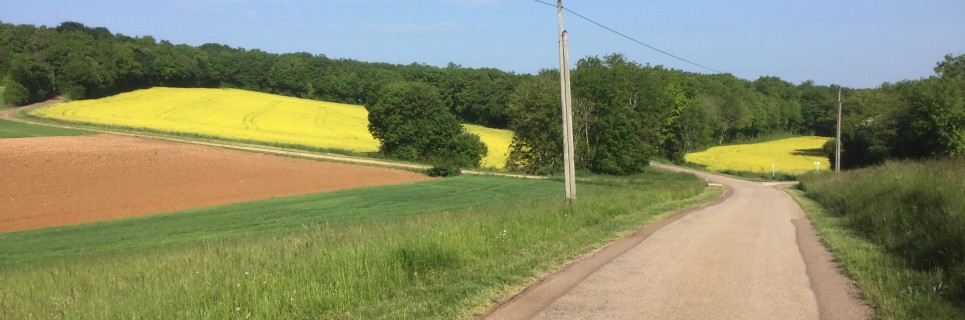
Outside the cities in the countryside we walked between farms that looked really fertile. As we walked towards the southeast and summer we saw the wheat gradually emerging from the rich brown soil right through the various stages until the last few days we have seen well formed heads of grain with their soft beards pointing to the heavens. The wheat at the early stages has a lush de ep green that sometimes looks like satin and sometimes like velvet. As we walk over the hill every new vista has fields of wheat interspersed with fields of golden rapeseed. Then there are fields of sugar beet and fields of crops that we can only guess what they are. When last we walked through France much further south we wondered how France could be a player in the world wheat market as there were comparatively few wheat farms and none very large. In the north, although by Australian standards they are tiny, they dominate the countryside.
Now we are in Reims. In our next post we will talk about this city.
2 comments so far
Comments are closed.

Great news that you are doing so well!! Making great progress! You are making me want to return and start all over again. Isn’t Sister Lucy gorgeous? xx
Enjoying your blog
Thankyou for sharing your adventure
Cheers walkmag