

… Our Continuing Journey
Well, this is a continuation of the previous post. We left you when we were leaving Ulm and here under are the details of our walk towards Switzerland.
The intention is to cover as far as the Swiss Border however maybe we will need yet another post because of the number of photos that we would like to include. Switzerland, France and Spain will be with less bla…..bla ….bla as we are so far behind. I believe that we have indulged in too many words.

Side view of Ulm Cathedral

Corner Tower of the Cathedral in Ulm
Sunday the 28th of April we left in the direction south-west, finally towards Lake Konstanz that is 154 km from Ulm so Switzerland was getting closer. Since our track, today was by the side of the Danube on our way out of the city we had a glimpse of the Fishermen’s and Tanners Quarter which is the older part of Ulm and since the seventies the trendier part of town.


The Danube when leaving Ulm
This area has many lanes, tiny bridges and really cute streets harbouring colourful guest houses and fashionable cafés. This area was not always as it is today. It was a rough area where poverty and crime prevailed, many people were broken by their status and the impossibility of getting out of it.
The Swine Markets were located in the area, also the Oat House and the Tanneries. All these businesses were part of the economic fabric of that period, all of them had a place in the old city by the river Blau. Each of these businesses sustained the income of some and the miseries of others. In those years palatinate donkeys carried sacks of grain and other food stuff from the mills and depots at the river Blau to the palace, the wealthy areas, other towns and villages.


The Tanners and Fishermen’s area as it is today
When you walk these streets you can imagine the fishermen and the tanners and their wives portraying a group of “no consequence people” that did not need to be protected. The protecting walls of these years were there to keep the royals and nobles from danger. The “dull sort of people” were left out, they lived by the Blau, unprotected, no walls to stop the river eroding their properties day by day, plagued by illnesses and death.

The old towers by the Blau River wall
The situation was getting out of proportion and someone woke up to the fact that life without the people from the south part of the city was going to be bad for the economy. They accepted that they had been unfair to them and something needed to be done. Finally, after the recognition that the south part of the city had been unfairly treated in 1480 the authorities built a protective wall by the Danube and extended the quarters of fishermen and tanners towards this wall.
The south part of the city was restructured and many houses were saved. The wall by the Danube improved the life of the ones that lived in misery. Later in the 19th century this area was declared a heritage area and was transformed into a tourist area and hundreds of people visit the place every year.
When we walked down to the Danube we left behind the last small bridge and the last renovated house which is part of the old patrimony.

Patrimonial houses by the protectiowall
Now the track offered a million dollar view, the Danube (Donao) was going slowly the surface was with no ripples and the water was silent, it was difficult to figure how deep it would be in this area. The river has trees and greenery on both sides and this frames it’s majestic appearance. Birds with their pretty tunes are singing and every now and again the call of a hawk that dives looking for some feed in the paddocks. The rest is silence which we interrupt with the click click click of our hiking sticks and the sound of our steps.
After a kilometre more or less our eyes had a real treat when we were able to see the most beautiful lilacs. For years we haven’t seen such a big display of these flowers, this was a real treat to the senses. The colours varied from white to deep purple I am sure that they were welcoming the Spring.


Lilacs of various colours
They were growing in almost every garden and also in the wild, their perfume saturated the air and the deep green leaves contrasting with the flowers made the way just spectacular.
Soon day walkers were entering the track, also cyclists, joggers and other locals going about their daily business made the area very busy at times, however, this movement of people did not diminish the beauty of the day.
After a long while, there was a bifurcation of the river and it appeared that it had changed its course. Our walk towards Grimelfingen was getting longer and longer. The realisation that the Danube was not there anymore was a bit of a shock. Not only did the big stream disappear it was replaced by a smelly muddy stream mostly covered by thick lots of reeds and some kind of bamboo.
Well, you didn’t need to be too clever to realise that we were walking now by the side of a stream of serviced water which was directed to the treatment plant. How unpleasant and it was impossible to get out of the track immediately, perhaps in around 2-3 kms we were going to be able to move out to the main road. It was just like we got the opportunity to move away from this area, unfortunately, we changed to a more difficult walking condition.
Supposedly we needed to do 7.0 km to Grimmelfingen, however, the last sign before abandoning the smelly track indicated that the 7.0 km was 9.0km “oops” a mistake from our guide book.
Well, we left the official track and took the road, hopefully, we were to do better. Once on the road, we realised that we have come out by the Manufacturing Park which is on the skirts of Ulm far from the town just at the limit of another district. That was great we were going to have the opportunity to see this area first hand and appreciate “the miracle”.
The Manufacturing Park is very impressive from the road and goes for many kilometres and displays high safety features like cameras and security gates. I got the impression that the car manufacturers are separated from the pharmaceutical and the food plants etc. Well w,e are convinced that this is a great project that has big chances of delivering positive results.
Once we passed the area we turned right and went straight ahead, little we knew that the road was one of the busy ones. Luckily there was a path wide enough to avoid the cars coming toward us, however, after a while, this disappeared and was replaced by metal barriers by the side of the road and our chances of safety were diminished.
On our left side we could see the train rails and in the distance, the track of Saint Jacob appeared every now and then. It was a bit concerning and we were moving very slowly. What a nightmare, we were not able to return to the other track as the train rails were separated from the road by high wired barriers. After another km when less expected we found a bridge which allowed us to abandon the main road and we continued until Grimelfingen through the Saint Jacob track.
On entering Grimelfingen we came across a mum, two daughters and two of the daughters’ friends walking towards Santiago de Compostela, we chatted for a while and then split as we needed to get some food and rest.
We stopped at a Bakery asked for coffee and sandwiches. Richard, as usual, got to talk to a lady that listened to him with great interest. Then they walked away across the road and returned to the Bakery where I was chatting with the young lady that was running the business.
Soon Richard and his new acquaintance returned delighted as the lady went to show him where to take the continuation of the Camino and they found the shell. It was incredible she had noticed the shell a few days before.
That was good work so off we went walking in the direction of Oberdischingen. It soon became obvious that the distance to our destination was going to be much bigger than calculated by the “experts” that prepared the guide books.
Erbach to Konstanz
Well, the way out of Grimelfingen was just fabulously beautiful through green fields, the sky was so blue and the sun was shining however it was not hot because a fresh breeze was around.

On the way to Erbach

Erbach from the road in
We went straight ahead until we got to Erbach where was the property of a Baron that is the benefactor of the area. He has a palace in the middle of a park and had built a magnificent church dedicated to San Martin.

San Martin Church from the distance

Inside San Martin church built by the Baron’s ancestors
He has a real castle and all the community has great respect for him and his philanthropic approach to the local residents.
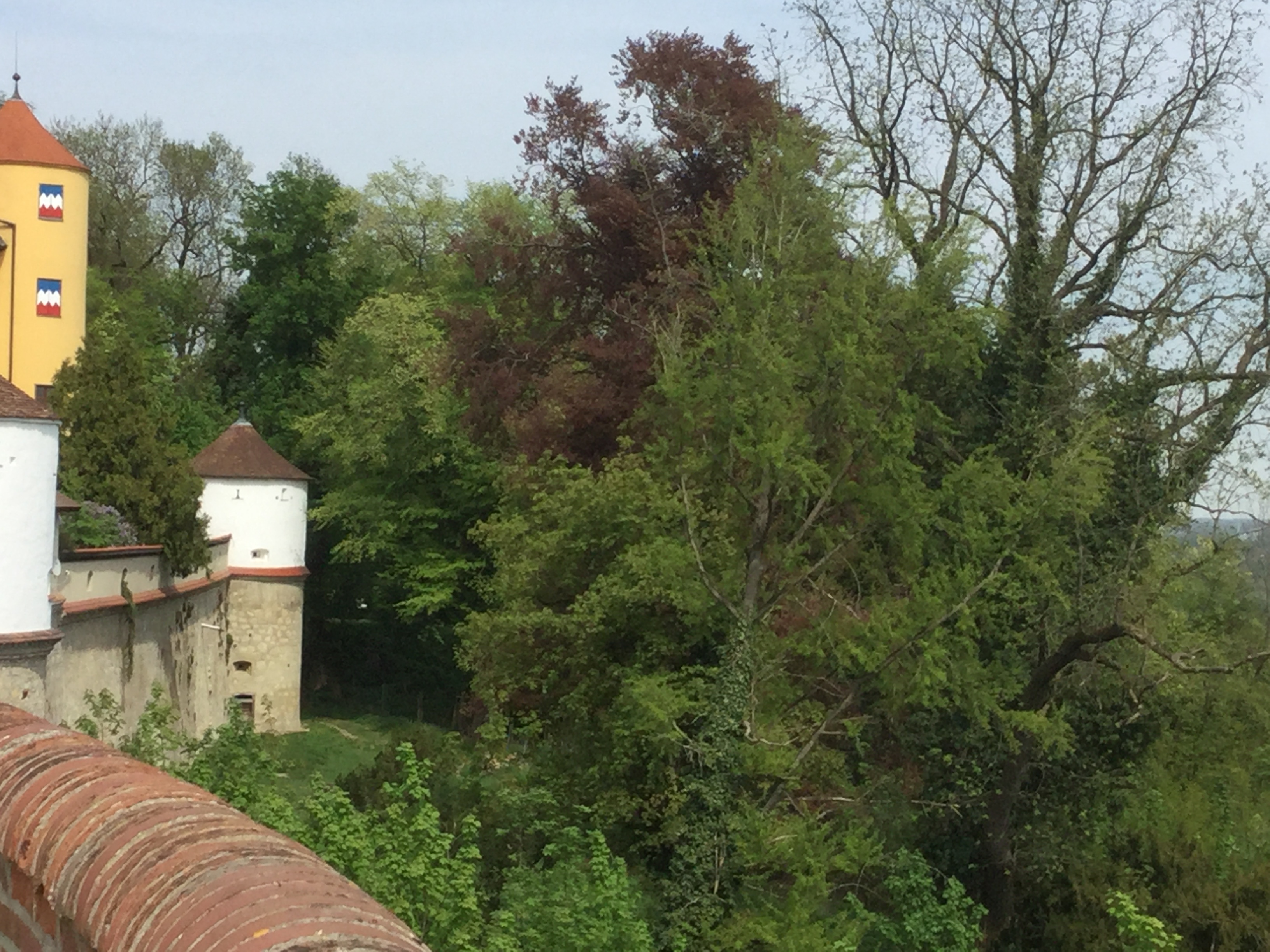
The Baron’s Castle Tower
I can’t explain how happy and light we felt after walking in this pleasant walk after having that bad walk earlier in the day on the main road. I am sure that the pictures will talk for us.

Richard in front of the Church
We continued on our way and a few kms after, we entered a long track with red soil, it was crossing paddocks and fields. Soon we commenced to ascend a mild but long …long hill, which took us to the Cursillo Haus and that was not without having the usual climbing up a serious hill to end the day.

Saint Jakob in front of the Cursillo Haus
The Cursillo Haus is a type of religious place that accommodates pilgrims “in style”. They also organise meetings of religious groups and develop courses for different associations.
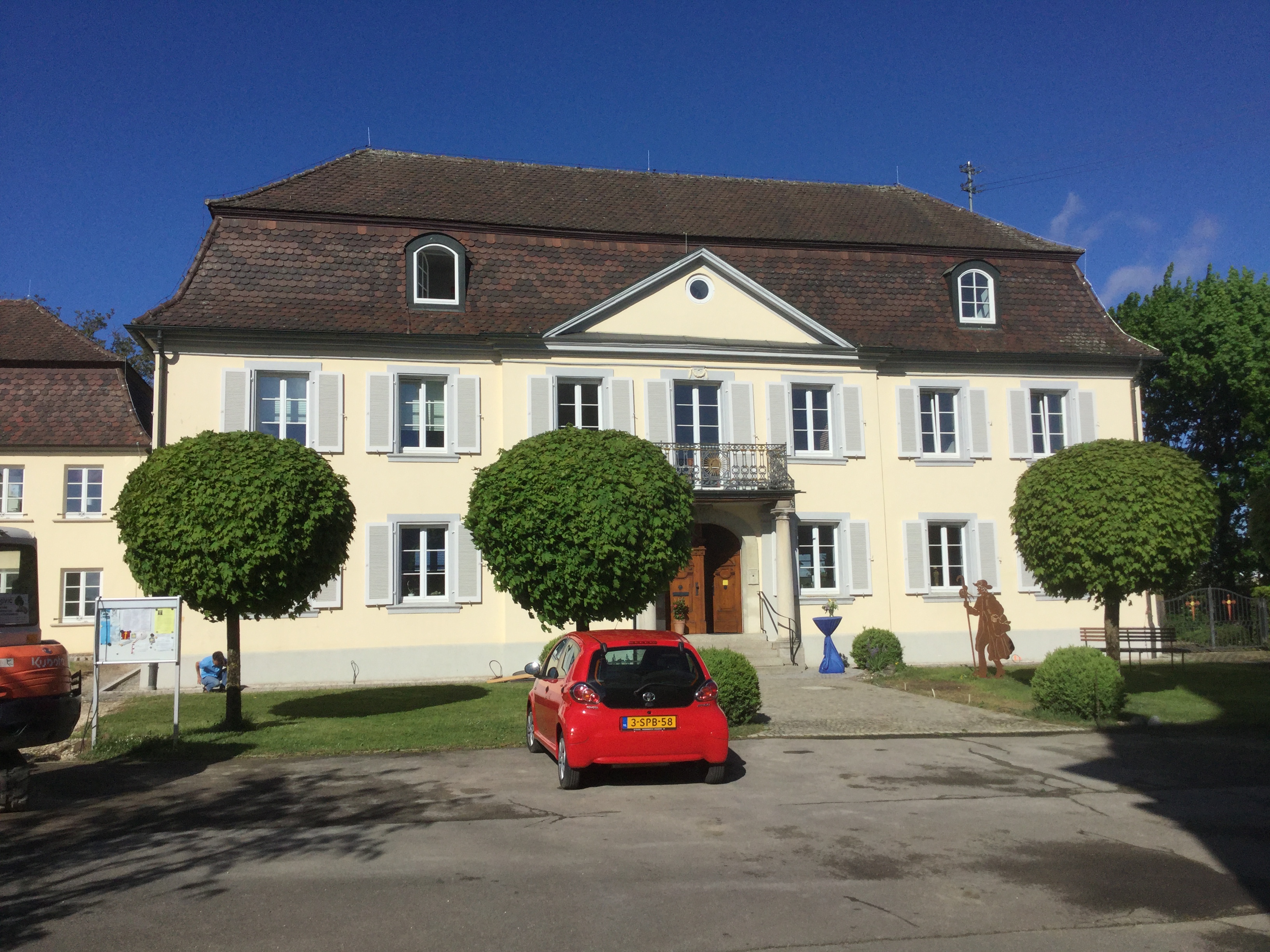
The Cursillo Haus in Oberdischingen
They offer conference rooms and catering for the attendants. This place is run by the Catholic Church which has a great manager in charge and the rest are volunteers or “hospitaliers” as they call themselves. They come from all over Europe to be working here for a defined period of time. The Manager came from Hydleburg so Richard called her the student princess much to her amusement.

The Student Princess
This group is a great support for the Pilgrims. The rooms are individual and there is a bathroom well designed which is shared by people in adjacent rooms. You never know who you share with as the system only permits one person at a time into the bathroom. Whilst one person is in the bathroom the door of the adjacent room is locked automatically electronically.
We arrived on Saturday the 28th of April to the Cursillo Haus and on Sunday the Archbishop of Stuttgart was coming to bless the new wing of the building and this visit was a great honour for this group. We were invited to stay for the mass and ceremony and were photographed with the Archbishop by the local Newspaper as we were “the novelty of the day” first because we were coming from Australia to do the Camino and second because Richard was 86 years old. For many that was incredible, so we had a brush with fame. The things that you do when you are away from home.

The Archbishop of Stuttgart and Friend
The group leader of this place mentioned that Gerhilde Fleischer who pioneered Jacob’s way between Nüremberg and Konstanz was going to be in the area sometime during the following week. The manager of the Haus offered to drive me to a dinner that was going to take place to meet Gerhilde. Unfortunately, we could not afford the time so we limited ourself to sending a note to her. Richard and I travelled with Gerhilde’s group in 2013 from Nuremberg to Konstanz and we are very fond of her. We admit that we were very sad to miss the opportunity to meet with her this time.
During the stay at the Cursillo Haus, we met a lovely couple Rudolph and Ruth. They were talking to us for a long time on Saturday at dinner time. They appeared to be such a happy couple but unfortunately, she is dying from bone cancer and her life is disappearing slowly and with lots of pain. Rudolph is devastated and has no idea of what will happen after she is not around anymore. It was sad to see that, but it was inspiring to see how much they cared for each other.

Rudolf and Ruth
His work was with the administration of the European Union. He had responsibility for a section of Europe and was somewhat bemused by the fact that it was extremely difficult to get different regions of Germany to let alone different Countries to cooperate.
We also met a woman from the Netherlands who is a painter. She had a show of her art work on the Sunday in the garden outside the building and part of the sales she made were going to support the Cursillo Haus.

Aquamarine glass on copper stands

Bird escaping from cage

Another Sculpture with emerald stones on a metal stand
Inside in the eating room, there was this painting. I just could not believe that there are still women that feel so strongly about men.

“A WOMAN NEEDS A MAN LIKE A FISH NEEDS A BICYCLE”
Her show also included a young musician who played beautiful music.
All went well for this group, everyone was happy with the results of the day and our experience of the event reminded us of how distant our lives are from this class of activities.
Monday 30th of April 2018
Early in the morning, we continued our way towards Konstanz. We crossed the Danube once more.

The Blue Danube
Our plan was to walk further each day to cover the 160 kms left for us and finish the German stage. We were planning to arrive in Konstanz by the 7 or 8 of June. The way to Schemmerhofen was beautiful and pleasant.

Most of the track was easy and we went through a few very attractive villages. We did part of the way with another pilgrim a girl that was volunteering at the Cursillo House. We went through Ersingen crossed the Donau (Danube) River then arrived in Rißtissen a town where there is yet another Baron that declared himself a “patron” for an Australian Artist that is very well known in his family at home and nowhere else. Rißtissen is dedicated to his art, what a laugh. I was starting to believe that the Baron titles in this area grow on trees.

Australian Artist’s work
Life is full of surprises and how. On walking into a coffee shop to get water we found our friend Gerhilde who was with some people having morning tea. What a surprise just when we thought that we would never see her again. This was a lovely moment, we had a coffee with her and spent some time chatting. Her news was that she finally wrote and published a book on the route from Nuremberg to Konstanz. Unfortunately, it was not published in English.

Gerhilde Fleischer
Finally, the running of this business has become commercial and I understand she is still part of it but not in the front line.
Well she and we have changed our paths in life, and in the last five years we have changed our direction, however, we still have something in common and that is our love for the “Jacobsweg”
We said our goodbyes and we continued on our way and finished crossing Rißtissen which is a nice place, after 3 kms at Niederkiche we got to a lovely chapel in the middle of a manicured little park.
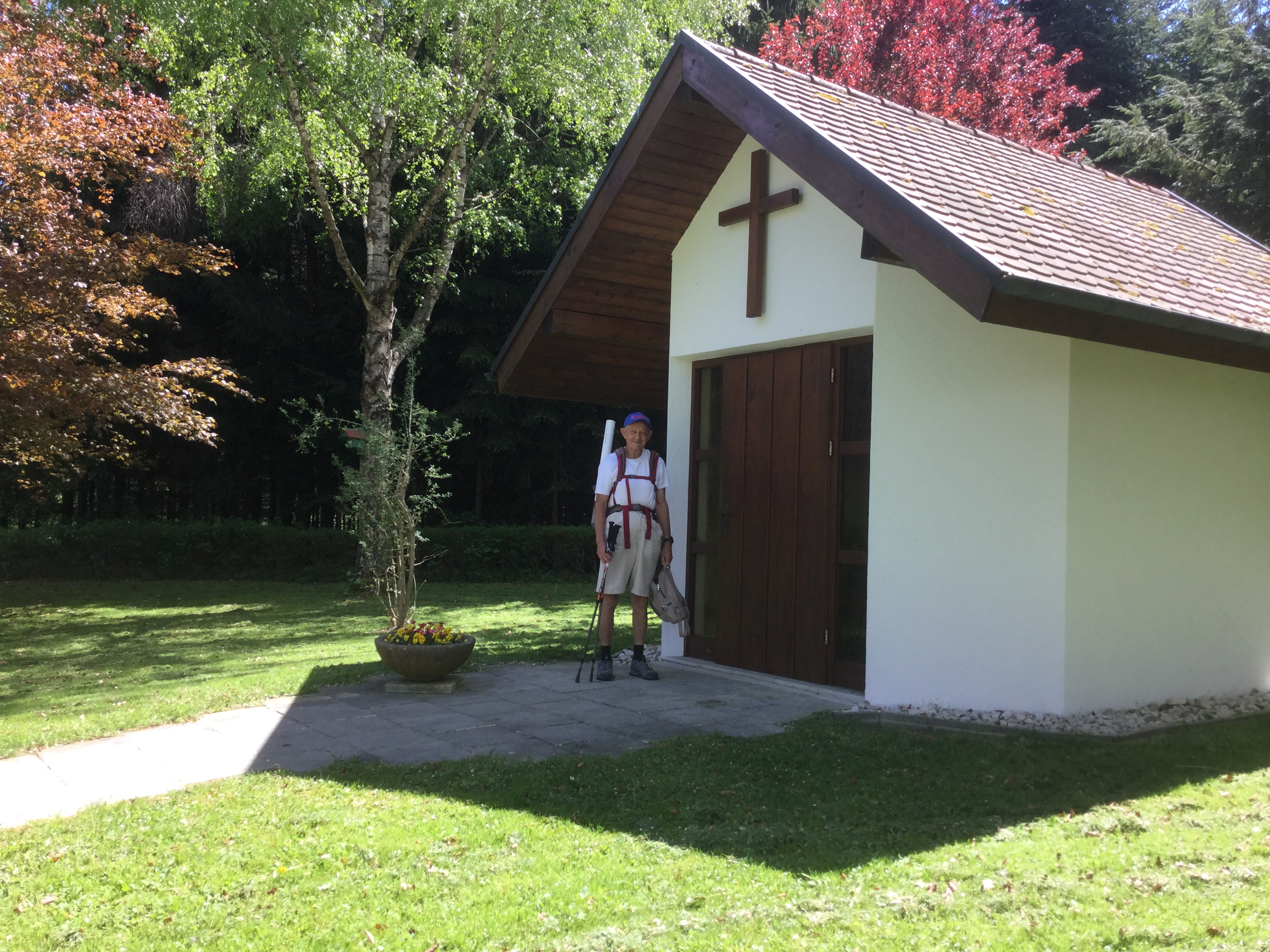
The small Chapel
Still in this area were pink cherry blossoms exhibiting their exuberant beauty.

Cherry Blossoms
However, we also found many lilacs that grow prolifically in this region. Untersulmetingen and Obersulmetingen showed some superb examples of lilacs.
After walking 18 km I was starting to feel serious pain in the lower back as still, I had not fully recovered from my fall in the forest when marching to Wöllstein a few days before we arrived in Ulm. I had to make a serious effort to continue and suddenly I could see the bell tower of the church at Schemmerhofen that gave me the energy to continue.

The Bell Tower when we were closer
After another hour on the way, we entered the village.

On the way to the house where we were to stop for the night, we noticed a lot of young people buzzing around a Platz moving the arms up and down. Obviously, it was a buzz about something that was on the ground. We thought nothing of that and continued looking for the address. After about 300m we got to the house where a kind family takes in pilgrims, that are walking to Santiago de Compostela. They do not put a price on the “herberg” and breakfast is provided. The pilgrim is supposed to give a donation on departure. That is incredible generosity, however, may take advantage and give nothing or a ridiculously small amount. We agree that in some cases it is justified but not in many.
Franziska and Bert received us at their doorstep with such a kindness and helped us to the area where we were to stay. Then proceeded to give us a cup of coffee and the most delicious rhubarb and cheese tart, it was so tasty. We talked for a while with Bert as he spoke English and we found that he and his fishing mates were off to Iceland. The purpose of his trip was a fishing expedition for men only so their wives were having a break. Also, we found that the following day was a free day in Germany it was a long weekend here.
The 1st of May is called “MayDay” which is an ancient festival to welcome Spring and drive away Bad Spirits. People celebrate around a tall wooden pole which is adorned with ribbons of many colours and young people dance around the Maypole holding the ribbons and forming a colourful pattern. The Maypole is erected as part of the festival and in this day many people get engaged or married and many men declared their love to that special girl by leaving a love note at their garden. Also in modern times, this is an occasion to celebrate the workers’ rights.
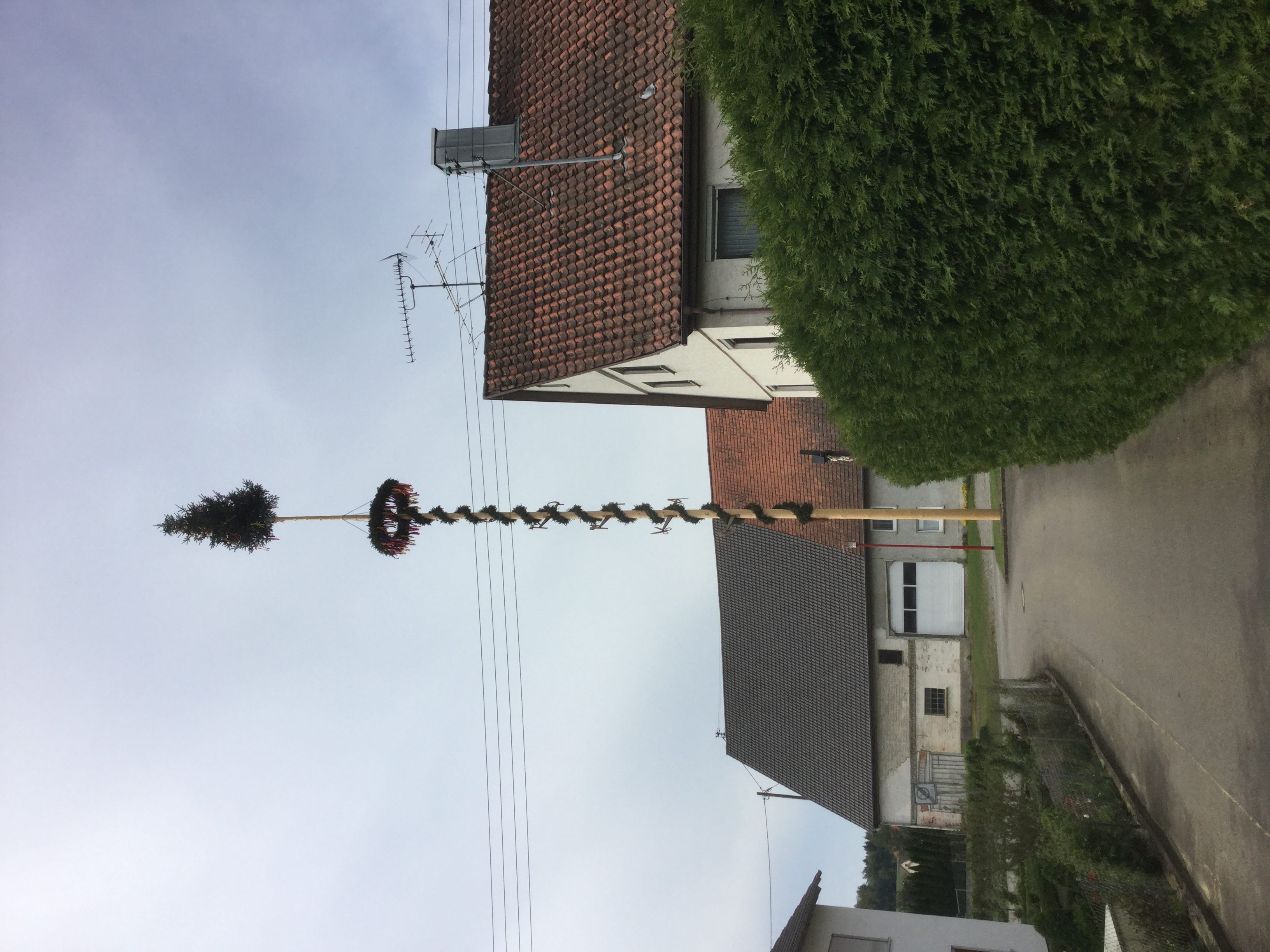
A simple Maypole
The big buzz at the Platz that we noticed on arrival was because the Maypole that was erected and adorned the night before was chopped down by some vandals, to the disgust of many people in the village. It had never happened before as everyone looks forward to the event.
Well, we were advised that the breakfast was to be served at 07:30 next morning. After the breakfast we paid and we were about to leave when Bert let us know that he and Franziska were going to take our backpacks to Biberach where we were to stay that night. They had noticed that I was limping and the next 20km could be a bit difficult for me. I could not believe it, such kindness and generosity you don’t find every day. We did not accept but they insisted as most probably it was going to rain during the day and the way could be very slippery. Well, we put on our parkas and started the way free of a backpack. This was a dream without this weight I could walk much better and my back and knees were not hurting so much.
1st of May we were to do 22 km

Walking in the Forest without a backpack
The way was beautiful with lots of green forest and flowers the track was easier than expected and we were doing a good time, a bit of rain in the morning was replaced by a cloudy day that showed the sun every now and again.
The first 3km were on a track around the forest and green fields, then we moved to a small village. Obviously, in this area people live off agriculture and sales of wood from the many plantations of pines.

Pine trees cut for winter fuel
The people that do the woodcutting live in pretty neat and tidy villages with interesting churches sometimes adorned with religious images on external walls.

Typical neat and tidy German town

The small church in Äpfingen
When we crossed this village we entered the beautiful forest and walked through it for a long while.

Walking the forest
We found another walker that indicated that the place where we were to stay in Biberach was quite comfortable and provided good food. He walked with us for 30 minutes near enough and then he took a turn to the right as he was going to meet his dad.
We continued until we got out of the forest to a big open space that had three tracks none of them marked by the coquille the Saint Jacob. Then we noticed an old couple that was also walking the track of Compostela. We had a chat. They were testing a new map that showed one old route which people claimed to be a “genuine” old track, whatever that meant. So they turned in another direction to us. Richard used the map that he downloaded from Pocket Earth and we found the shell and entered a village that looked very empty as it was a holiday and everyone attended picnics and family affairs.
We were a bit lost for a while because suddenly we lost the track as there were some streets which were blocked by public works. From the distance, we noted that the couple that we found earlier also was looking for a way out. Well, they turned left and we went right. We continued through the road as the track was interrupted and after a while, we noticed that the couple was coming from the left side and joined us. We talked for a little with them and again each continued their own way.
Finally, we arrived at the village that was 3 km from the town of destination what a relief, then a car stopped by our side. There were the other two walkers that we saw so many times during the day offering to drive us into the town of destination because the 3km that were left were only at the entrance. Still, we needed to walk 6km to reach the walled city. well I needed no more to get convinced and gladly accepted the offer as by then we had already done around 29,000 steps and I was tired.
These people left us outside the Gasthof and we thanked them for their kindness and entered the place that had the reception in their restaurant.
… TO BE CONTINUED
(we have included too many pictures and the post is way over our traditional length)
1 comment so far
Comments are closed.


Dear Ercilia,
Every day of the more than usual wait to hear from you was worthwhile and rewarded with your two posts about your walks through Southern Germany into Switzerland. Knowing that you both are in good hands, relieved any possible concern. You have a wonderful, descriptive way to convey your experiences, encounters with new and former acquaintances, trials and tribulations. There is just one drawback: making me more and more jealous. It’s wonderful you have included more photos this time; no words would be able to capture the lushness and tranquillity of German country paths. Loved the photos of those magnificent lilac trees, only thing that was missing there was their intense perfume. But once experienced – as I have on many occasions in Germany – it stays with you for ever. So, more pictures please, they do enhance even more your tales.
Your frequent opportunity to take stock is such an incredibly rare gift, not because of lack of time but we just don’t make time to create peace around us and within us.
Eagerly awaiting more chronicles.
Brigitte Lucey