
France and Switzerland’s Francigena route has been left behind. Italy is now ahead of us and we have great expectations. We will visit several regions of Italy as the Via takes us through Val d’Aosta, Piamonte, Emilia Romagna, Toscana, Latium and a bit of Liguria. All very promising great surprises and challenges are waiting ahead and Roma will become our last target
09 July leaving Le Grand Saint Bernard and crossing the Italian border

Photo:Tunnel early on the road
Well here we are again looking forward to the last part of our adventure. Crossing the border to Italy is letting us know that our final goal is no more than 40 days away if things go to plan. Goodbyes and good wishes were given and received and weatherwise the morning was shaping to be uncertain, the sky was really grey and the wind was cold and cutting our faces. We decided to walk the main road as the trafic was not too bad early morning and the alternative route looked a bit more dangerous because of the snow and the experience of getting a bit lost a couple times the last two days .

Photo: Flowers on the skirts of the mountains
Soon after crossing the border we reach a tunnel that was almost covered by snow however the internal part where the cars run was cleared and for us was easy to walk through it . At the other side of the tunnel was the road waiting for us and we could see that the next 1900 mt descent would be easier than the way up that we had yesterday. From the top we were able to see the down road twisting and turning, also we could see the mountains which flanked the road like they were protecting it.
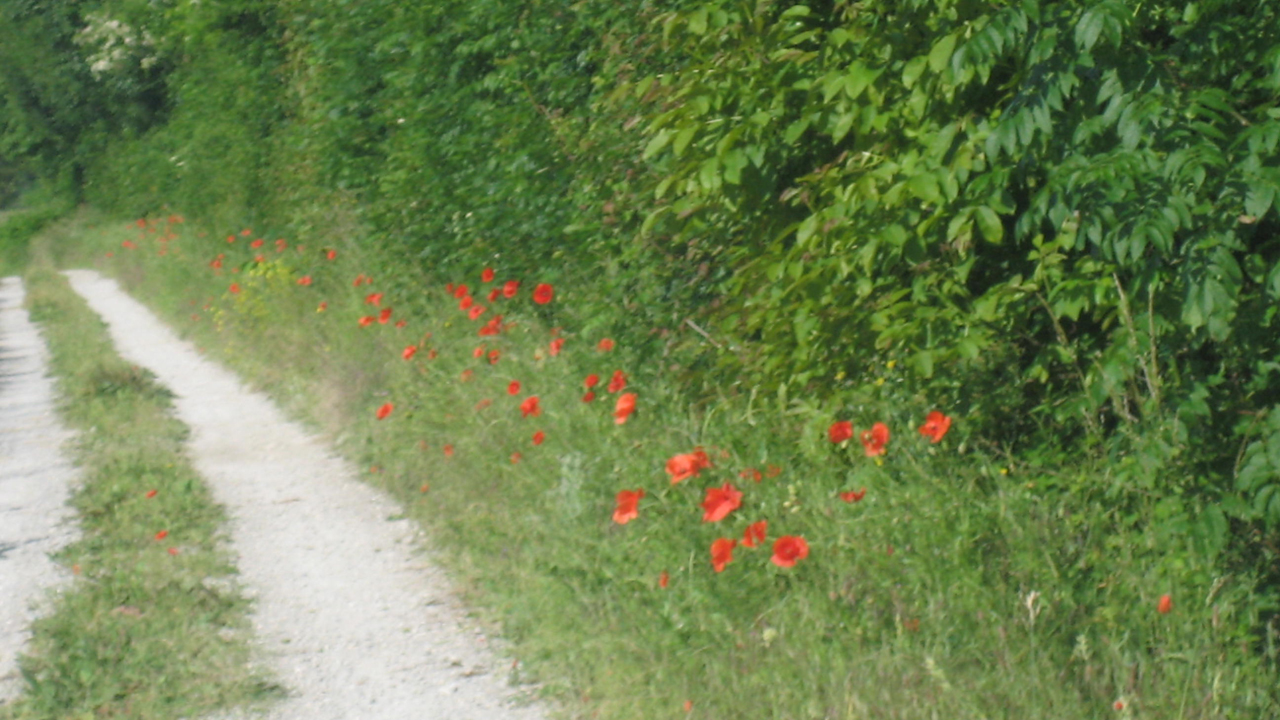
Well let us tell you that what lays ahead of us is unbelievable and amazing. The beauty of the mountains covered by snow in some places with caprichoses shapes and colours is absolutely outstanding. The foot hills were adorned with wild flowers as if someone had been preparing the area to surprise and delight some eager Pilgrims on their way. We just were speechless and just thankful for the blessings received.

After the tunnel we saw the amazing mountains
We walked at a good speed and passed some of the waymarks and seven km later we reached the Bourg of Saint – Rhėmy only to find out that the Hotel / restaurant was still closed only to open the following Monday when school holidays were to commence . Well we crossed the river and walked a lovely smooth uphill path until two km later we reached Saint Léonard a very small but cute town which offers some facilities to the pilgrims. We were delighted to find a place to stop as our legs knew that we had descended several kilometres with not much rest. It is incredible that after walking France and Switzerland still there were some muscles that were not used until yesterday and today. We stayed at a very nice place called La Vielle Cloche. The host was very helpful and bent backwards to make sure that we were ok at her facility.
That evening we had dinner at a local cafe that was run by a family, the chef spoke English so it was easy to order. We had a magnificent fresh salad and a plate of ham and cheese to share.
We walked back to the Albergo and for a change we got the wrong turn but did not get lost. Next day by 7:00 am we had a beautiful breakfast the lady offered us a variety of home made bread, cheese, cold meats, eggs and home made cake. What a feast!! She packed some lunch for us and by 8:00 we were on our way to Aosta as per plan.
On the way to Aosta
We left the town by the side of the church of Saint Léonard and descended through a very steep grassy track. It was narrow and soggy as there was a goodly amount of rain the night before. The way was rather pretty but by no means easy. We got to the first village after crossing the river and it was very cute. Once again the European style of beautiful gardens prevailed. We continued walking through a flat area for about 7 km. Leaving this village we encountered an uphill track once again. It was very steep and lasted around 5 km where the way flattened a bit but was still uphill. This town was Saint Oyen dated to the 11th century full of charm very well looked after. We stopped here for coffee and water as usual and there we met a young man who was marketing the cheese that he was making at his farm located outside Pavia in the way to Milan. He specialised in Gorgonzola and Mozzarella type cheese and his clients were restaurants and pricy outlets of fine food. He was so impressed with Richard and his fitness. The caffe was owned by a young Spanish couple and the lady was born in Argentina. They were nice and they could not believe our adventure. They did a big fuss of Mr H as they were amazed about his fitness.
We continued our way through a very colourful path and on the way found some tourists having their lunch under the beautiful trees. Unexpectedly the rain arrived once more around a kilometre before reaching Étrouble. We were planning to walk as far as Aosta however in view of the change of weather and the fact that Etrouble was beautiful we stopped here for the night.

Étroubles
Before finding accommodation we sat on a bench by the tourist office which was undercover and had our cut lunch provided by our kind hostess from the previous night. After finding accommodation and dropping the backpacks we visited the town and learned that the place has existed since Roman times, and some of the buildings are dated to the 11 century, we found several sculptures and pieces of art in the streets really this town was an open museum.
Next morning we continued our way to Aosta. Unfortunately the rain started again early. We arrived at our Albergo called Cechino named after a famous boxer. The place was pleasant and clean. As soon as we dropped the backpacks we went to explore the town and found it to be very special. We noticed that the people were very courteous and were eager to help.
We called at Wind telecommunications people only to find that there was one attendant and 20 people waiting, so after one hour or so we were attended and and our questions answered.
We continued our city inspection and we were able to see marvellous ancient buildings and streets flanked by old trees. The rain started to be heavy so we went back to the Albergo to collect dirty clothes and do our washing at the town laundromat
In the evening we went to the corso had a table of local cheese cold meats and a glass of wine and we called it a day
Next morning was nice.The sun was shining and we were able to see the flowers in the balconies and gardens in all their glory. What a gift to be able to see this array of colours and shapes under the sunlight and the blue sky. The breakfast was nice and we knew that it would keep as going to mid afternoon or so.
Aosta to Ivrea
The surroundings have changed and on leaving the town we found other pilgrims that were in a furious race to arrive somewhere and we don’t think that they had much chance to see what was around them.
The way out was steep and relentless however there were orchards and small vineyards and we saw several pomegranate trees covered with little fruit. The houses were big and all had a piece of land that was carefully cultivated. As we approached the Saint Christopher’s Chapel the uphill proved to be a real challenge but we continued marching ahead only to find out that the place was closed to the public that day.

Saint Christopher
Near the chapel we met a French pilgrim Jean Paul a lovely man. He was on his way to Budapest following the way of Saint Martin so he was going to walk the Francigena until Luca. We had a bit of a chat and we were sorry that perhaps we would not see him again.
We continued the way always in the lower part of the via as the rainy days had perhaps made the top route too slippery. The via was very beautiful at this stage and we walked through areas well protected and shady. The route passed very interesting areas where vineyards were a feature. Around 9km after leaving the city of Aosta we encounter the convent of the Carmelites nuns – a Spanish congregation. This was a very stylised modern convent. We stopped and had a chat with a fellow that was working in an orchard by the convent. He was very interested in the Australian people and their life style. Obviously he was involved in the convent. Then we continued our way hoping to get to our destination Nus by early afternoon as we were booked in a local Albergo there. Actually we thought that we were some 10 km away. The route continued to be pleasant and we reached the Quart Castello built in 1185 we spent some time taking photos and we saw a young couple sitting on rocks at the front of the building. We continued the way and soon after the young couple that was at the Quart Castello caught up with us and greeted us very friendly. The girl spoke English and we spent some time with them as she wanted to know about what to do to emigrate to Australia. After a while we said goodbye as we wanted to get to our destination before 17:00 hrs and continued what was an easy way to that point. Unfortunately this lovely way become a bit confusing and we turn into the woods were we took some very steep down path and could not find a way to go down to the main road. At the end of a very difficult period of time we reached the highway however we turn right instead of left. Lucky for us we find a group of 4 people talking by the side of an small vendor’s truck that obviously was delivering ice creams. We ask them directions to Nus and they explained that it was necessary to turn left and go back in the opposite direction and walk for one hour or so then it was necessary to leave the highway and turn left again into a road that suppose to have a bridge then we were to find the elusive town of Nus. They kindly gave us water and ice creams pops, what a treat! We continued the way and around half an our later the sky was dark and menacing, the storm was imminent. By now we knew that we will never make it to the place before six pm and we could not stop as nothing else was around Nus it was the only town that we could reach that evening. By six we called the Albergo to advise that we were late but we were told by the woman that took the call that we were not book at their place. This was bad news for us so we needed to make a quick decision so we decided that we would arrive at the Albergo and see what would happen. We imagined that under the circumstances, under heavy rain we could not be left in the street. Well we got to the place and adviced the chap at the desk that we have “prenotato” our accommodation with them and we were there to stay. The fellow was quite happy to show us to our rooms as he had our reservations in his book. The case was that the person who answered the phone earlier was not aware of the booking. Oh what a relieve we had a place to stay!!
As we walked out to the foyer after leaving our bags etc to our delight we noticed that Jean Paul was just arriving to stay at the same Albergo, that was good as it gave us the opportunity to have dinner with him and talk about his way to Budapest. The chap obviously is a devoted Catholic and is a man with faith and conviction. We also talked about French and Greek economies and of course we could not leave out the terrorist attacks in France. The dinner was good and not too expensive and what a coincidence the young couple that we met on the way that day were dining at the same restaurant, they come to say hi as we were leaving. After dinner we joined the street parade as they were celebrating some special day and at the door of the Albergo we went in and Jean Pul stayed to see a bit more of the festivity. We were very tired the tension of the later part of the day had made us very tired more so than the walk.
Next day was a Sunday and we met downstairs for breakfast before hitting the road again. The brekky was quite minimal so we decided that we could buy lunch earlier than usual.

Fénis Castle on the way to Châttillon
We left Nus hoping to get to Chantillon early. This was the next town with accommodation luckily the distance was only 18 km good for a Sunday and we expected an easy walk. We had a bit of trouble getting out of Nus as the marking was rather poor and in addition soon after leaving we had a severe storm. We thought that maybe we would not be able to continue. We waited under the roof of an empty office until it was safe to start again. By then we were in Fenis a very picturesque village quite touristic as they have a big castle that attracts buses full of tourists every weekend all the year round. We passed the castle, took some pictures and continued on our way. The way was lovely, a bit challenging in parts, but quite doable on a wet Sunday. When we reached the town before Chantillon a car stopped by our side and ask if we were Pilgrims to Rome and if we were walking from Nus this morning , that was a bit weird, and once we confirmed that yes we had started in Nus that morning they proceeded to ask if we knew Jean Paul a pilgrim to San Martin. What a coincidence!! We confirmed to them that we knew him and mention that we have had dinner together the night before and that he was well and very happy when we left him the night before. They were so happy that he was well and indicated that he was late for a meeting that he had with them at Chatillon. We reassured them that he was well and most probably he had started late because the weather. Jean Paul’s friends continued driving to see if they could pick him up further down the way. The world is so small we never know who we can meet, who could know about us etc.

We continued our walk and finally around 15:00 hrs we reached the skirts of Chatillon, stopped for a coffee and gelato and asked directions of how to get to the Albergo. It was not that easy according to the lady from the Bar as the town really was on the top of the hill (570m over sea level) like most towns in the North of Italy. Well we manage to get to the place where we were to spend the night and honestly it was an awful place.

The outskirts of Châtillon below the city.
The whole town had stopped in time, everything there was from the 1950s and our accommodation was very iffy. Well such is life and Pilgrims have to expect that you get what you pay for. Before getting to the Albergo we find our friend Jean Paul and his friend in the Main Street of the town, we were happy to find that he was well and his delay was caused for reasons of no importance. In the evening we had something to eat in the Valdesano restaurant, the only place open and we called it a day and went back to the Albergo to sleep. We left the awful place at first light and headed out to find a place to have some breakfast.
The day was sunny but the morning was very crispy and a bit cold but when you walk you warm up quickly. We walked around 5.0 km and stopped to buy water and have a short break at a little place that was run by a young couple. It was funny to see how they could not agree in a reception to prepare some kind of pasta to be prepared for the lunch that very day. After that we continued and reached a lovely place called Saint Vincent a very cute place by the lake that has a Casino in a pink Castle. This town is a very affluent place, obviously where the rich and beautiful live everything is pristine and the shops are elegant and very expensive. We stopped at the Tourist Office to find accommodation in a town call Isognes which is around 20km away. Unfortunately no accommodation was available in that town as most of the registered places have closed or were not operating until the week after. The tourist officer was fantastic. He called several places until he found a place for us at Verrès a bit further to walk but at least there we have a place where to sleep. Unfortunately in these towns there were no hostels or parishes available. We walked for several hours after having our sandwiches at the plaza of Saint Vincent we got to Verrès by 16:00 hrs, we had no dinner just went to the laundromat to wash our clothes.

Vèrres – Dora Balthea River and Duc d’Aosta Castle
The accommodation here was spot on even when the owners were not friendly and not very helpful. Next morning the breakfast was good and we left early to reach the next destination Port Saint Martin. The road to this town was very interesting and relatively easy: not many surprises.

Arnad on the way to Pont Saint Martin
That morning it was raining before leaving Verrès but soon the sun was shining again We walked for six hours before reaching our destination. The end of the day was cloudy and a bit miserable but still we did a good job of reaching Pont of San Martin by mid afternoon. For a while we were a bit confused with the directions and as we reached Bard it was not clear where to continue the track as our route was interrupted by a big castle/fort standing in the side of a mountain. The size of it was intimidating the Dora Balthea river was running through the side of this fort that was adorned by a very well looked after evergreen park, it was obvious that the locals were very proud of it. The area was full of tourists trying to visit the fort and of course paying a goodly amount to get in the funicular train and reach the top of the fort. The medieval village of Bard is nested in a dip gorge and the fort was built in the 11th century and later was destroyed by Napoleon Bonaparte in the year 1800 and it was rebuilt 40 years later.
Our issue was to find the way to rejoin the via and beside the Fort was a stone arch so we asked a builder that was remodelling an apartment across the street where could we cross this arch. He got very agitated as he understood our question but did not speak enough English to explain to us that to do that was extremely dangerous to try to cross through that area. He trie to let us know that we should cross the town through the Main Street of Bard. We could “non cappice ” what he was on about, flapping his arm in alarmed fashion and repeating ” Donnas way”. So we continued on and climbed to the Main Street of Bard and stopped at a Bar where we found a fellow that spoke Spanish so we thought our troubles were over as we would be able to make sense of all of this. Unfortunately he was as high as a kite and could not make sense. We continued crossing the town and then stopped at a little caffe were the owner was an English man that explained that we needed to continue straight ahead until Donnas and also explained the agitation of the builder was because the side area of the forte was under repair and people could fall into a black hole.
Following the instructions of the English fellow we finally reached Donnas and got out to the road by the river to take pictures as a bit of sun appeared. Unfortunately the fine rain settled in again, and we returned to the Main Street that soon became the Roman road of Donnas. About 100 metres later we had the most amazing experience, we walked into Donnas along an ancient Roman road built in the first century BC. The entry to the town via the Roman road is through the most incredible arch in the rocks that was made by the Romans. The road has grooves made by their chariot wheels. We imagined sitting in a chariot beside Julius Caesar or the Emperor Augustus and looking through the arch to the hillside beyond the town that would be very much as it was in their day. Donnas is down steps so it is not visible until you are through the arch. That is why our view from back on the road would be the same as that of the ancient Romans. Beside the road was a column carved out of the cliff face with XXXIV inscribed. This was the distance from Aosta.
Once we left the arch absolutely overwhelmed by the idea that there were the Romans crossing in their fabulous carriages and when on top of the hill they were to see the magnificent view offered to them through the Donnas Arch.

The Roman road into Donnas
We almost missed this arch because just before reaching this point it was raining and the Roman road was smooth and very slippery so we returned to the street.
We descended to the road down the steps beside the arch and then we were in the start of a wide and long avenue straight as a die, flanked by old trees. It looked beautiful even though the rain still was with us and the sky was dark.
After crossing a piazza covered by colourful flowers we got to Pont Saint Martin. This town has a very unique Roman bridge over the River Lys built in the first century BC which has a single arch it is also known as Ponte of the Diavolo (devil’s bridge) as many thought that it was built by Satan. In addition Pont Saint Martin has two Castellos one known as the Baraing built in 1883 of Neo Gothic style and the Castello of Suze in the centre of the town.
Almost immediately after arriving to the town we found our accommodation place, it was the cutest house in town it looked like a doll’s house covered in geraniums hanging from baskets also there were Fuchsias and some Orchids giving so much colour to such a dull afternoon.
This place was a luxury for Pilgrims run by a young couple with two lovely little girls. The young man was a teacher that was in charge of the towns’ band and also he was responsible for some of the writings of the Pilgrims route in the Aosta and Piemonte area. The place was impeccable the breakfast was superb and they were incredibly helpful.

Settimo Vittore lovely tow on the way to Ivrea
By next morning the rain was gone and the sky was blue and the day sunny. Ivrea was our next stop around 26 km away, we did not know what to expect of this town. On our way we passed some really interesting places such as Settimo Vittone with its terraced vineyards.
The young fellow from Pont San Martin arranged this accommodation for us at Ivrea and also arranged the price which was very good value for money. This place was not easy to find as it was nested in the corner of a plaza on the other side of the bridge and therefore was very quiet in the night.
The lady was waiting for us and she was lovely. Nothing was a problem for her, she was young looking and was running a farm and this bed and breakfast. This place was very clean and welcoming she showed the facility and advised us where to grab some dinner. We went to this lovely Italian joint where they sell traditional tucker. It was a Trattoria, the menu was simple and good and the prices more than reasonable. We had a salad each and a Pizza Margherita both very nice. We went back and washed clothes and packed for the next morning. The little bit that we saw of the town was quite nice and it was clear that this town was in good financial shape. This town has an interesting background in the year 100 BC the Roman Colony of Eporedia was founded on the Dora Balthea River. Nowadays it is a prosperous town that has an Olivetti Industrial Complex a well know international business that employs many people. Olivetti initiated their business building typewriters and calculators and nowadays is a powerful IT group. Ivrea also has an old castle which was built in 1328. Ivrea is the boundary between Val d’ Aosta and Piedmontese regions 18 kilometres.
Ivrea to Vercelli
On the next day we set out with destination Ropollo and to get there we walked approx.22 km. The route was somewhat unpredictable we crossed several built up areas however the marking was appalling several times we thought that we might have taken a wrong turn.

Lake Viverone on the way to Roppolo
Finally by asking several people we understood that to reach Ropollo we had to take Los Via Cavaglia and continue ahead without turning right or left. We were supposed to arrive to a place in Rapollo before 18:00 hrs and hence to get lost was going to be detrimental. As we walked the recommended via we saw a mother and daughter coming towards us most probably doing their daily excersise and we asked them if they new where was Ropolo and did they know of a place called Le Lune as we were booked there for the night. By the way we notice when they were approaching us that the mother was one of those very attractive Italian women and she reminded us of a movie star. So when she smiled we knew that she was very similar to Jamie Lee Curtis. Well the funny part of this was that yes we were in Ropolo and that the mum was the owner of the Le Lune. We walk with them to their place which was nice and conformable with beautiful garden and perfect manicured grass.
This area is mainly dedicated to agriculture. We went to find something to eat and found that there was only one place which offered food. We talked at some length to the owner and he indicated that Italy is in trouble, that the taxes are exorbitant and that the locals that lose their jobs have no government assistance, however, the boat people are given free housing plus free medical, transport, energy and schooling plus €30.00/day.” Obviously he is not happy Jane”.
The lady washed our clothes over night and next morning they were dry and folded. She was so nice.
The breakfast was absolutely delicious and on time so we left the place early and happy.
The family walked us to the entrance to say goodby as if we were old friends and waited there until we turned left and disappeared from their view. We took the track which was uphill very steep but soon levelled off and we entered a forest which was nice and cool. The temperature is higher every day and by ten o’clock we have reached the high twenties or low thirties.
We walked a few kms in the direction to Cavaglia, however we reached a fork where there were no signs and we were confused looking everywhere. Suddenly a man that was working in his vegetable garden saw us and put his tools down and came to the rescue. He indicated that the road that looked most likely was the wrong one. He also added that the day before a lady from the USA did not listen to his advice and ended up walking three km uphill only to find that she needed to return to the point where we were and take the other route. He talked to us about the way that agriculture was the main income of the people in this area and viniculture was the most important source of wealth from since the old ages. Fair enough from then on we walked through vineyards until we reached Cavaglia, Interesting town quite big and modern in their facilities even though their architecture was from the Renaissance. The main Iglesia San Michael Arcangel dated 17 to 18th century. It was huge like a cathedral and very well maintained and unusually illuminated by the sunlight. The catholic association was very much on Pilgrims and there were lots of facilities for them. Obviously they are very welcome and well accepted. We saw another pilgrim that was having beer at a bar he was old like us and was travelling by himself. We had seen him a couple days before.
We continued our way and entered the Rice country which was an experience to travel through such a flat country. By midday the temperature has gone up a lot and was high humidity in the atmosphere.

Wheat and corn on the way to Santhia
We arrived to Santhia where we stopped for lunch after walking 15km. The slides were black and the heat was well above 30 degrees C.very uncomfortable. This town has 10,000 inhabitants and appears to be dynamic It also has a huge Soccer stadium which we encountered on the way out.

Soya plantation on the way to Santhia
We found a place where to eat after asking different people as we were in the outskirts of the town and of course these areas don’t have many places available. You need to move to the centre. Unfortunately we could not afford that luxury as still we needed to walk 8.0 or 9.0 km to arrive to San Germano Vercellese where we were booked to stay overnight. The lunch was first class. We had big salads and a few bits and pieces that were suggested to us. The girl who looked after us was very kind and most probably related to the woman that owned the place. We drank 2 litres of water as we were very dry. The heat and humidity have made us lose a lot of water.
During the lunch a thunder storm passed over with not much rain, just wind and thunder. We left the place and walked by the side of the motorway which was very busy hence a bit dangerous. We made good time and arrived at San Germano Vercellese before 17:00 hrs.
We stayed at the Golden Lion hotel no other choice as we were warned that the other hotel available was worse. Well you take good with bad in this adventure. The town was horrible, dirty smelly and people looked depressed and unhappy. We left very early after having a cup of coffee with croissant that was really good. What a lovely surprise.
Our next destination was Vercelli a big town with population of approximately 47,000. The place was highly recommended and because it was a weekend we decided to stay there until Monday.
They had several interesting places and beautiful buildings which needed to be visited.

Rice field
Vercelli is known as the European Rice Capital as it is in this province where the biggest rice fields in Italy are found. Italian rice plantations have existed since the 15th century introduced by Venetians and/or Arabs into Italy. Obviously today Italians are very experienced in the cultivation of Rice and many processes and cultivation techniques have been develop by them. It is known that Leonardo Da Vinci helped to develop the Irrigation system for the rice fields of the regions of Vercelli, Pavia and Norvona. These systems were using the waters from the Po River and Lake Majori
Rice Irrigation System Cavour Canal
Italy today has 150 varieties of rice and their total production covers 65%of the European consumption of rice and they seem to export to other continents. Based on the rice business Vercelli is a rich area and has big co-operatives and also independents that handle the packing and classification of the rice’s quality. So we learned that Rice production is a very big part of the Italian economy.

Vercelli Monastery
Well enough of rice, we visited the cathedral, monasteries and the Synagogue, all very impressive places. The green areas of this city are very well looked after and as all places in Italy their gardens were exceptional.

When in Vercelli please walk this avenue it is lovely
By now since we entered the Aosta Valley on the 10th of June we have walked around 153 km and still we have another 770km to go.